
Introduction
Esports has transformed from a niche subculture into a global phenomenon worth billions of dollars, watched by millions of fans across platforms like Twitch, YouTube, and major broadcast networks. With professional tournaments offering multi-million-dollar prize pools, the competitive scene has evolved to mirror traditional sports in many ways. Teams no longer rely solely on the raw talent of players; instead, they recognize the value of structured training, strategy, and support staff. At the heart of this ecosystem are esports coaches and analysts, who provide the framework that enables professional players to perform at their best.
While the spotlight often shines on players and their flashy gameplay, the unseen labor of coaches and analysts plays a crucial role in shaping competitive outcomes. Much like in football, basketball, or cricket, esports teams now understand that preparation, mental conditioning, and deep strategic insights separate champions from contenders. This blog post will explore the role of esports coaches and analysts in detail, covering their responsibilities, challenges, impact on teams, and how these roles are shaping the future of competitive gaming.
1. The Evolution of Coaching in Esports
Early Days: Player-Led Strategy
In the early 2000s, competitive gaming was far less structured. Teams were often player-driven, with captains making strategic decisions. Matches were won or lost largely on individual skill, reflexes, and informal teamwork. There was little room—or budget—for specialized staff.
The Shift to Professionalism
As esports matured, particularly with the rise of titles like League of Legends, Dota 2, and Counter-Strike: Global Offensive, organizations began adopting professional management structures. With millions at stake, they could no longer rely on ad-hoc decision-making. Coaches emerged as essential figures, bringing order and strategy to increasingly complex games.
Modern Coaching in Esports
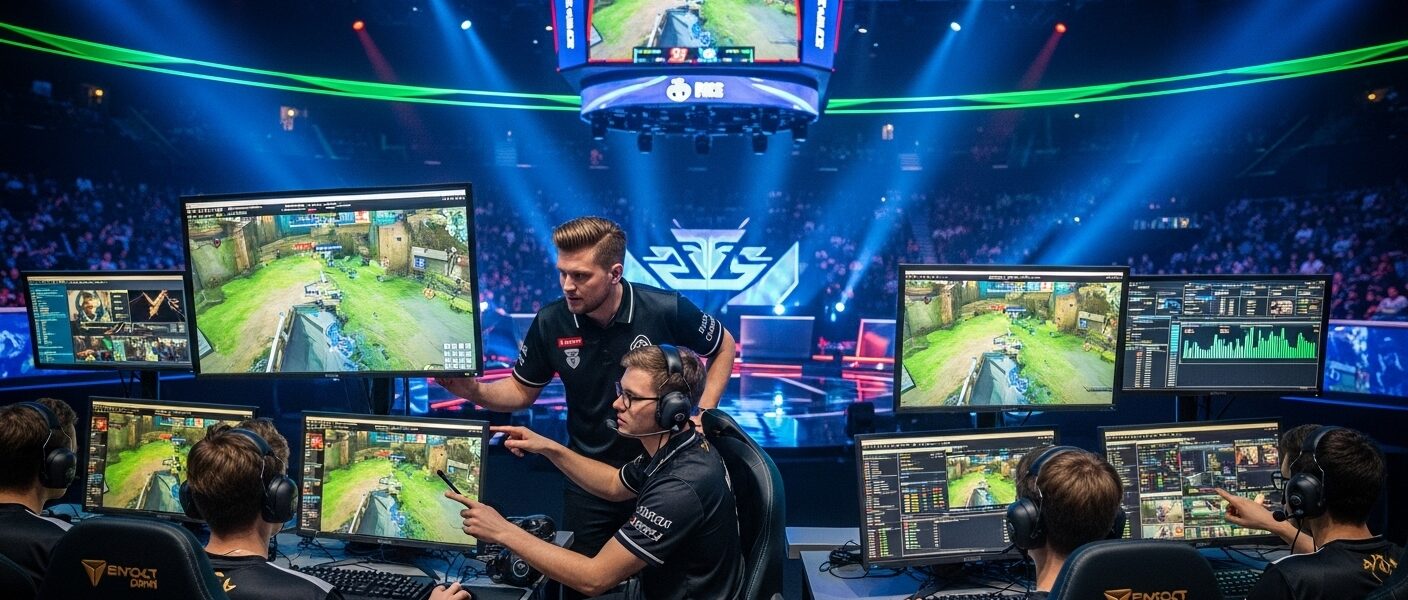
Today, coaches in esports are integral to team success. They manage not only strategies and tactics but also player development, morale, and discipline. Their work extends beyond the game itself, encompassing physical fitness, mental resilience, and even public relations training.
2. Responsibilities of Esports Coaches
Coaching in esports is multifaceted. Here are the core areas where coaches contribute:
2.1 Tactical Strategy
Coaches devise strategies, draft plans, and in-game tactics that maximize a team’s strengths while exploiting opponents’ weaknesses. In games like League of Legends, where champion selection can make or break a match, the coach’s input during the drafting phase is invaluable.
2.2 Player Development
Beyond strategies, coaches work on improving individual player performance. This involves identifying weaknesses, offering constructive feedback, and helping players develop new skills. For example, a coach might help a CS:GO player refine their positioning or decision-making under pressure.
2.3 Team Chemistry
Team synergy is critical in esports. Coaches foster communication, resolve conflicts, and ensure that players trust and respect each other. Without a healthy team dynamic, even the most talented rosters can underperform.
2.4 Mental and Emotional Support
The pressure of performing on a global stage can be overwhelming. Coaches help players build mental resilience, manage stress, and maintain focus. Many teams now employ sports psychologists alongside coaches, highlighting the mental intensity of esports.
2.5 Fitness and Lifestyle Guidance
With long practice hours and intense competition, physical and mental well-being are vital. Coaches encourage healthier lifestyles, including fitness routines, proper sleep, and balanced diets. Some even coordinate with fitness trainers.
2.6 Communication with Management
Coaches act as liaisons between players and team management, ensuring that organizational goals align with competitive performance.
3. The Rise of Esports Analysts
While coaches are the visible face of team leadership, analysts work behind the scenes, dissecting data to uncover competitive advantages.
3.1 The Data-Driven Era of Esports
Modern esports generates massive amounts of data—kill/death ratios, gold per minute, damage dealt, win rates on specific maps, drafting trends, and much more. Analysts parse this data to identify patterns and create actionable insights.
3.2 Key Responsibilities of Analysts
- Scouting Opponents: Analysts study rival teams, their playstyles, and tendencies. For instance, in Dota 2, an analyst might note that a team favors early aggression with specific heroes.
- Performance Metrics: They track each player’s stats to pinpoint areas of improvement.
- Draft Preparation: Analysts collaborate with coaches to recommend champion or map picks based on statistical advantages.
- Meta Analysis: With frequent game updates, analysts quickly adapt strategies to the evolving “meta.”
- Feedback Loop: Analysts provide reports after scrims (practice matches) and tournaments, helping refine strategies.
3.3 The Value of Analysts
Analysts bring a scientific approach to esports. While coaches provide intuition and leadership, analysts ensure decisions are backed by evidence. This partnership elevates team performance by combining experience with hard data.
4. Comparing Esports Coaches and Analysts
Though their roles overlap, coaches and analysts bring different strengths:
| Aspect | Coach | Analyst |
| Focus | Strategy, player development, morale | Data analysis, trends, statistical insights |
| Visibility | On stage, visible during drafts | Behind the scenes, rarely public-facing |
| Decision-Making | Real-time and strategic | Evidence-based, supports coach decisions |
| Skills Required | Leadership, communication, mentorship | Data science, game theory, research |
Together, they form a symbiotic relationship that strengthens a team’s overall competitiveness.
5. Impact on Esports Performance
The influence of coaches and analysts can be seen in major tournaments:
- League of Legends Worlds: Teams with strong coaching staff, like T1 (formerly SK Telecom T1), consistently perform well. Legendary coach kkOma is often credited with molding world championship-winning teams.
- Counter-Strike Majors: Coaches like Zonic (Astralis) redefined CS:GO dominance by combining tactical preparation with analyst-driven strategies.
- Dota 2’s The International: Analysts are critical during draft phases, where picking the right heroes can secure victory.
Their collective efforts often spell the difference between early elimination and lifting a trophy.
6. Challenges Faced by Coaches and Analysts
6.1 Lack of Recognition
Unlike players, coaches and analysts rarely receive fanfare. Their contributions often go unnoticed, which can be demotivating.
6.2 Rapidly Changing Metas
Games like League of Legends update every few weeks. Coaches and analysts must constantly adapt strategies, leaving little room for stability.
6.3 Limited Authority
In some teams, star players may resist coaching advice, creating friction. The balance between respecting player autonomy and enforcing discipline is delicate.
6.4 Burnout
The long hours of scrims, reviewing footage, and traveling for tournaments can lead to mental and physical exhaustion.
6.5 Job Security
Unlike players who gain sponsorship fame, staff roles are more volatile. Underperforming teams often replace entire coaching staffs after losses.
7. Skills Needed to Be a Successful Esports Coach or Analyst
For Coaches:
- Strong leadership and communication skills.
- Deep understanding of the game’s mechanics and strategies.
- Ability to manage diverse personalities.
- Emotional intelligence for conflict resolution.
- Adaptability in fast-changing esports landscapes.
For Analysts:
- Expertise in data collection and interpretation.
- Proficiency with software tools for analysis.
- Thorough understanding of game updates and patch notes.
- Strong research and reporting skills.
- Collaboration skills to integrate with coaching strategies.
8. The Future of Esports Coaching and Analysis
8.1 Integration of AI and Machine Learning
Analysts may soon rely on AI to process gameplay data in real-time, offering immediate insights during tournaments.
8.2 Increased Professionalization
As the esports industry grows, we can expect more formal certifications and training programs for coaches and analysts.
8.3 Expansion of Support Staff
Beyond coaches and analysts, teams now hire nutritionists, psychologists, and fitness trainers. This holistic approach mirrors traditional sports.
8.4 Virtual Reality and Simulation Training
Future analysts may use VR tools to replicate in-game scenarios, allowing players to practice specific situations.
8.5 Greater Recognition
As fan understanding of esports deepens, coaches and analysts will likely gain more visibility and respect from the community.
9. Case Studies of Successful Coaches and Analysts
kkOma (League of Legends)
Widely considered one of the greatest coaches in esports history, kkOma led SK Telecom T1 to multiple World Championships, demonstrating the value of disciplined coaching.
Zonic (CS:GO)
Zonic transformed Astralis into a dominant force by integrating rigorous tactical frameworks and embracing data-driven analysis.
7ckngMad (Dota 2)
Serving both as a player and coach for OG, 7ckngMad (Ceb) emphasized mental resilience and team spirit, contributing to OG’s back-to-back TI victories.
These figures highlight how impactful strong leadership and analysis can be.
10. Conclusion
Esports coaches and analysts are the unsung heroes of competitive gaming. While players execute the flashy plays that make headlines, it is the structured guidance of coaches and the data-driven insights of analysts that set the foundation for success. Together, they create a balance of intuition, leadership, and science that propels teams to championship levels.
As esports continues its meteoric rise, the role of coaches and analysts will only grow in importance. They are not merely support staff—they are architects of competitive excellence, shaping both the players and the games themselves. The future of esports will likely see even more sophisticated coaching systems, technological integration, and professional recognition, cementing their role as indispensable pillars of the industry.