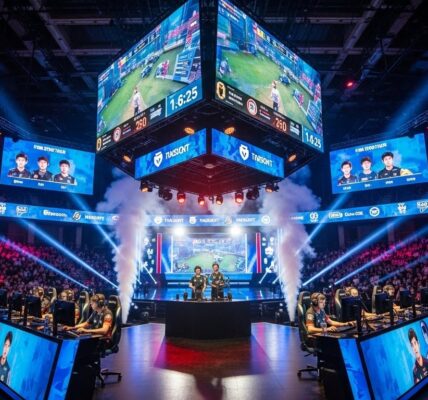


In the last two decades, esports has undergone a profound transformation, evolving from a niche hobby into a multi-billion-dollar global entertainment industry. What was once considered a pastime for a small group of enthusiasts has exploded into a massive sector that attracts millions of viewers, players, and investors worldwide. Competitive gaming is now a prominent fixture on the global entertainment landscape, drawing parallels with traditional sports in terms of viewership, sponsorship, and professionalization. In this post, we explore the growth of esports, its impact on both the gaming industry and popular culture, and the future that lies ahead for competitive gaming.
The Early Days of Esports: From Arcades to LAN Parties
The history of esports dates back to the early days of video games when players gathered in arcades to challenge each other for the highest score. However, competitive gaming began to take on a more formal structure with the advent of personal computers and the internet in the 1990s. Early multiplayer games like Quake and Warcraft allowed players to compete against each other via local area networks (LANs). These small, informal LAN parties became the breeding grounds for what would eventually become the global phenomenon of esports.
In 1997, the Cyberathlete Professional League (CPL) was founded as one of the first major esports organizations. The CPL hosted tournaments for games like Quake and Unreal Tournament, and it became a pivotal moment in the establishment of esports as a competitive pursuit. These early competitions were a far cry from the highly organized and professional leagues of today, but they laid the foundation for the growth of esports into a legitimate industry.
The Role of Streaming Platforms: Revolutionizing Esports Viewing
A significant milestone in the evolution of esports came with the rise of live streaming platforms. Before platforms like Twitch, esports events were often restricted to a small group of players and a limited audience. With the launch of Twitch in 2011, everything changed. Twitch allowed players to broadcast their gameplay in real-time, enabling fans to watch and engage with esports events from around the world.
Twitch quickly became the dominant platform for gaming content, offering a space for gamers to stream their competitions and interact with audiences. In 2014, Amazon acquired Twitch for nearly $1 billion, signaling the massive potential of live-streaming gaming content as a global business. Today, Twitch boasts millions of active users and attracts millions of viewers for major esports tournaments and streams, cementing its role as the primary venue for esports viewing.
The Rise of Professional Esports: Teams, Leagues, and Tournaments
As the popularity of esports grew, the scene began to evolve into a professional industry. Major games like League of Legends, Dota 2, and Counter-Strike: Global Offensive began to offer lucrative prize pools, and esports tournaments became much more than just casual competitions. Esports began to take on a more structured form, with professional teams, coaches, analysts, and managers becoming integral parts of the ecosystem.
One of the biggest catalysts for the growth of professional esports was the creation of major esports leagues and tournaments. The League of Legends World Championship (LoL Worlds) was first held in 2011 and has since become one of the most prestigious tournaments in the world, attracting millions of viewers and offering multi-million-dollar prize pools. Similarly, The International for Dota 2 quickly became one of the most lucrative esports tournaments, with the 2021 edition boasting a prize pool of over $40 million, funded by the game’s community through in-game purchases.
As esports leagues became more organized and professionalized, they began to mirror traditional sports in many ways. Teams formed around popular games, with players being signed to multi-year contracts and sponsors offering significant financial backing. Corporate brands began to take notice of the massive audiences that esports was attracting, and the floodgates opened for sponsorships and advertising deals. Companies like Coca-Cola, Intel, Red Bull, and Nike quickly entered the esports space, offering sponsorships, advertising, and merchandise deals that helped boost the industry to new heights.
Esports as a Cultural Phenomenon: Gaming and Beyond
Esports has transcended its origins as a niche subculture and has become a mainstream cultural phenomenon. What was once a hobby primarily enjoyed by young men has evolved into a global movement that spans generations, genders, and regions. Esports has permeated popular culture in various ways, influencing everything from fashion and music to social media and entertainment.
The Social Side of Esports
One of the most striking aspects of esports is the sense of community it fosters. Online platforms like Twitch, Discord, and Reddit have allowed players and fans to connect, share their experiences, and build global communities centered around their favorite games and players. Fans no longer just watch esports; they engage with the content, chat with fellow viewers, and interact with players in real time.
Esports communities have become vibrant, diverse, and dynamic spaces where individuals can share their passion for gaming, discuss strategies, and cheer for their favorite teams and players. Major events like the League of Legends World Championship have become more than just competitions—they are cultural events that bring fans together in celebration of gaming as a whole.
Influencing Other Industries
The cultural impact of esports is also felt outside the world of gaming. Brands across industries are embracing esports as a marketing tool, recognizing its vast audience and global reach. Esports has become a major influence on the fashion world, with esports teams and players often signing endorsement deals with apparel brands like Adidas and Puma. Even traditional sports teams are getting in on the action, with soccer clubs like Manchester City and basketball teams like the Golden State Warriors launching esports divisions.
Music has also played a role in the rise of esports. Events like the League of Legends World Championship Final have featured live music performances, bringing together popular artists and gamers. In fact, the intersection of gaming and music has become a crucial part of the esports experience, with esports events featuring live concerts, music videos, and collaborations with major musicians.
The Economic Impact of Esports: A Multi-Billion-Dollar Industry
The financial growth of esports is staggering. According to Newzoo, the global esports industry is projected to generate over $1.5 billion in revenue by 2023, driven by sponsorships, media rights, ticket sales, and merchandise. This figure represents just the direct revenue from esports itself and does not account for the broader impact the industry has on related sectors such as technology, entertainment, and tourism.
Sponsorships and media rights are by far the largest sources of revenue for the esports industry. As esports events have become larger and more organized, they have attracted the attention of major corporations looking to capitalize on the massive audience of young, tech-savvy consumers. Brands that were once focused on traditional sports have increasingly turned to esports to reach new, digital-first generations. Streaming platforms like Twitch, YouTube, and Facebook also play a major role in monetizing the esports ecosystem, with these platforms securing broadcasting deals for top-tier tournaments and offering ad revenue sharing for streamers.
In addition to sponsorships and advertising, esports has become a major player in the gaming industry itself. Publishers like Riot Games, Valve, and Blizzard Entertainment have all invested heavily in esports infrastructure, from game development to tournament organization. This has created a self-sustaining ecosystem where game developers, publishers, players, teams, sponsors, and broadcasters all contribute to the industry’s financial growth.
The Global Nature of Esports: Breaking Down Regional Barriers
One of the most remarkable aspects of esports is its global reach. Unlike traditional sports, where geographical barriers often limit the scope of competition, esports transcends borders. With the internet as its stage, players from different parts of the world can compete against each other in real time. This global nature has allowed esports to grow in every region, from North America and Europe to Asia, Latin America, and the Middle East.
The Rise of Regional Competitions
While global tournaments like the League of Legends World Championship and The International dominate the esports scene, regional competitions are also crucial to the growth of the industry. In regions like South Korea, China, and Europe, esports have a deep cultural and historical connection. Countries like South Korea are known for their thriving esports ecosystems, particularly in games like StarCraft, League of Legends, and Overwatch. The infrastructure in these regions, including dedicated esports arenas and government support, has played a pivotal role in fostering the growth of professional gaming.
In recent years, other regions have begun to catch up, with esports leagues and tournaments emerging in Southeast Asia, Latin America, and even Africa. These regions are not only developing their own esports talent but also contributing to the global esports scene by introducing new strategies, styles of play, and unique game preferences. As esports continues to grow globally, regional competitions will become even more important in providing opportunities for players from different backgrounds to rise to prominence.
The Future of Esports: Technology and Beyond
The future of esports looks incredibly promising, with continued advancements in technology, innovation in broadcasting, and further global expansion. Emerging technologies such as virtual reality (VR) and augmented reality (AR) could revolutionize how players and viewers experience esports. VR has the potential to create fully immersive gaming environments where players compete in virtual worlds, while AR could enhance the spectator experience by overlaying real-time data and interactive elements during live streams.
The continued professionalization of esports will also lead to greater opportunities for players, coaches, analysts, and other professionals. As esports continues to expand, there will be more avenues for individuals to pursue careers in various sectors of the industry, from gaming content creation and event management to business operations and data analytics.